Budae jjigae, literally “army base stew,” was born near U.S. military bases in Korea after the Korean War, when spam, sausages, and other American commissary goods were stretched into a communal, spicy stew with Korean vegetables and gochujang-style broth. This “Nagasaki” version is a milder, milk-and-bone-broth spin that some Korean home cooks and casual restaurants have popularized — the ham is soaked in milk first to soften its saltiness and canned taste, and the broth leans on rich beef bone stock instead of a heavy chili base.
It’s the kind of dish Koreans make on a chilly evening for a crowd, cooked right at the table in a shared pot with mushrooms, tofu, potato, and a homemade pork meatball floating in a savory, slightly nutty broth finished with perilla seed powder and crown daisy greens. It’s comforting, a little indulgent, and endlessly customizable depending on what vegetables you have on hand.
This recipe is worth making because it’s a one-pot meal that feeds several people, uses easy-to-find pantry staples like canned ham, and delivers a deeply savory broth without hours of simmering, since it relies on ready-made bone broth as its base.
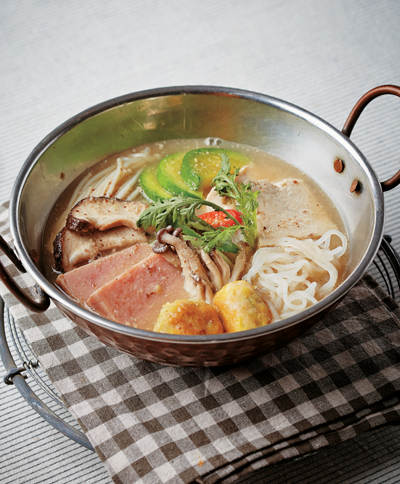
Ingredients
- Main: canned luncheon meat (SPAM-style) (30g / about 2 tbsp cubed)
- Milk (100g / about 1/2 cup)
- Silk konjac noodles (50g)
- Onion (30g)
- Oyster mushrooms (25g)
- Shiitake mushroom (10g)
- Enoki mushrooms (30g)
- Cheongyang green chili pepper (5g)
- Red chili pepper (5g)
- Potato (30g)
- Korean radish (30g)
- Tofu (40g)
- Zucchini (30g)
- Perilla leaves (3g)
- Crown daisy greens (10g)
- Meatball: ground pork (20g)
- Chopped green onion (5g)
- Minced garlic (5g)
- Ground black pepper (1g)
- Salt (1g)
- Flour (10g)
- Egg yolk (20g)
- Broth: beef bone broth (sagolmuk) (300g / about 1 1/4 cups)
- Dried kelp (dasima) (5g)
- Seasoning: ground perilla seeds (deulkkae garu) (15g)
Instructions
- Blanch the canned ham briefly, then soak it in milk; also blanch the silk konjac noodles quickly in boiling water with a splash of vinegar added.
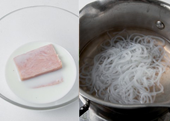
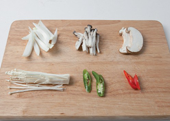
- Cut the onion into thick strips, tear the oyster mushrooms by hand, slice the shiitake mushroom following its natural shape, trim the root end off the enoki mushrooms, and slice both the cheongyang chili and red chili on a diagonal.
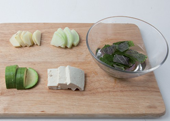
- Slice the potato, radish, and tofu about 0.5 cm thick, cut the zucchini into half-moons, and cut the perilla leaves into thin strips, then soak them in cold water to remove their sharp flavor.
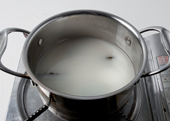
- Add the dried kelp to the beef bone broth, bring to a boil, then let it cool slightly.
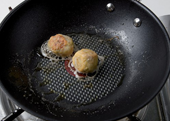
- Mix the ground pork with the chopped green onion, minced garlic, ground black pepper, and salt to form small meatballs; coat them in flour and beaten egg yolk, then pan-fry in 5g of cooking oil.
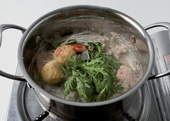
- Arrange all the ingredients neatly in a pot, pour in the beef bone broth, bring to a boil, and finish by adding the crown daisy greens and ground perilla seeds.
Tips & Variations
Where to shop: Canned luncheon meat, silk konjac noodles, dried kelp, and ground perilla seeds (deulkkae garu) are all available at Korean or Asian grocery stores, or online. Beef bone broth (sagolguk) can often be found frozen or in shelf-stable cartons in the Korean grocery soup aisle; if unavailable, a rich beef or chicken bone broth is a fine substitute.
- Soaking the ham in milk is key — it mellows the canned, salty flavor and gives the meat a softer texture, so don’t skip this step even if it seems unusual.
- Crown daisy (ssukgat) has a distinct, slightly bitter aroma; if you can’t find it, baby spinach or watercress is an acceptable, though milder, substitute.
- Silk konjac noodles can sometimes have a strong smell straight from the package — blanching with vinegar as instructed helps neutralize it.
- Feel free to adjust the spice level by using more or less cheongyang chili, since this stew’s broth is milder than a classic gochujang-based budae jjigae.
- The pork meatballs can be made slightly ahead of time and refrigerated before pan-frying, which makes assembly at the table quicker.
Nutrition
- Calories: 342.7 kcal
- Carbohydrates: 3.99 g
- Protein: 5.37 g
- Fat: 3.63 g
- Sodium: 778 mg